Now that there’s an agreement for the Amish craftsmen to make cabinets–not only for the kitchen and bathrooms, but for the guest room, family room and mudroom as well–I am not surprised that now a three-way consultation starts in earnest. Marc is drafting up detailed drawings of the cabinets, which will assist Robert in arriving at the drawings that will be used for fabrication. But there remain details: whether to have vinyl or melamine linings? How to space the “full overlay” doors over the face frame? How deep to make the cabinets? Linda and I have decided that ‘pull-outs’ are the best means of storing food and implements. These are ‘horizontal’—very much like drawers—in the wider cabinets. But it is also possible to have what I call ‘vertical’ pull-outs—whole frames of narrow shelving that come out with the door when pulled, and permit easy access from both sides.
After peppering J&R’s Robert Phillips with many queries about features of the cabinets, I am almost at the point of signing the contract. But then learn from Caleb that the contract actually is between the construction company and the cabinetmaker. I see the point—the contractor is responsible for the whole project.
Sean, owner of Morrissey Builders, evidently sacrificed part of his Christmas to provide counsel—at my request—about which cabinet builder to select. Both firms appear equally qualified, and I make the decision on relatively minor grounds: old-fashioned perhaps tougher finish, and the sustainability cachet of Amish craftsmanship.
Rain on snow! This made a yukky mess out of the yard at 2021 Harriet.
Inside the house, evidence of progress. The barrel ceiling of the master bedroom has been all framed in by Jerome.


Marc, Caleb and Katie Leaf (the architect at SALA who has done the drawings) began our usual running consultation. Electrician Tony soon showed up, so the meeting moved from room to room, as he peppered us with questions about where to place circuits, outlets and switches—endless detail, and he was entirely accommodating as we did our thinking out loud. Some choices were not evident, such as how to arrange LED strip lighting in the cove ceilings. Marc bore with me as I agonized about the width and finish of the ceiling moldings.
During this endless consultation, I can’t seem to break away to connect with Katharine, who divided six-seven hours between a café and the very cold car. I am without excuse. We then drove to New Hope, to receive a houseful of appliances into storage (purchased early due to black-Friday discounts). Alas, the truck was late, and then brought the wrong refrigerator to boot. We sent it back, then scooted for home, Katharine trying unsuccessfully to thaw out her feet. Barely made it back in time for her to freshen up, thaw out, and head out to an all-night party with friends.
While we are on the way back, the custom cabinet builder makes a bold bid for the job—slashing his quote by almost $5000, so as to undercut the Amish bid by a couple thousand dollars. Oddly enough, the new bid is not really tempting. But I pass it along to Marc, Caleb and Sean for their advice how to proceed.
Daughter Katharine and I drive down for a mid-afternoon meeting with David Klemenhagen of Accent custom builders in Ramsey. He convinced me that Accent could mill, stain and seal the wooden trim. Indeed, I had to admit that the finish they apply was far smoother—albeit with less color and character—than what I was able to coax out of the 100-year-old woodwork.
Had a serendipity, with historical roots. More than twenty years ago, Phil Holtan, and accomplished wood turner and pastor, generously shared his shop—and time—in helping me make a cradle for our daughters. While we now see each other perhaps once a year, it dawned on me that we might renew the old collaboration in ‘turning’ on his lathe the four columns that will grace the entry hall and parlor of the house. I sent him drawings of ‘Tuscan Doric’ columns, and he readily agreed. Why Doric? Ever since traveling in Greece, I’ve been smitten with the simple elegance of this 3000-year-old style.
I let the local wood supplier know that his bid is not accepted. What this means, in effect, is that I am moving towards having Accent, the Ramsey-based supplier, provide not only the 4000 feet of millwork–all the various pieces of window and door trim—but then having them do the staining and finishing. It doesn’t make sense to haul all the raw millwork wood up here, make it beautiful, then haul it back down.
Sometimes cost issues do motivate some action. About 10 doors are needed, doors that will have six horizontal panels—exactly the design of the 14 old doors in hand.
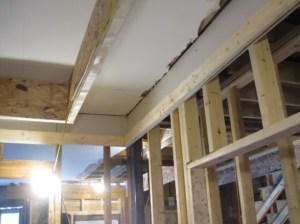
The pace seems to be picking up, major commitments being made: contractors will start “roughing in” the air ducts, then the plumbing, and then the electrical—the order goes from bulkiest to skinniest, on the lived experience that it is easier to route an electric wire around an air duct than vice-versa. We’ve borrowed from the “Not so big” architectural movement (which started at SALA) the idea of ‘dropping’ the perimeter of our ceilings by one foot, while rounding the central portion into an arch or more accurately, an upside-down ‘tray’. In this way there’s plenty of room to run air ducts across a ceiling without having them showing. The carpenters have started framing in the ‘soffits’ or spaces along the perimeter.
Back in Fargo I was disconcerted to hear that the Andersen Company is still working on our windows and doors order. It’s been two months since we gave them a final tally—although Marc has had to make a minor adjustment or two since.
Tried to move another process along. Back in August, I had a bid from a nearby supplier of architectural grade lumber to supply the large quantity of trim that we need for the doors and windows (in addition to the refinished 100-year-old trim). I’ve sat on this bid while Caleb has been in touch with another supplier closer to the Cities. Now he’s shared their bid with me, and they seem to be ‘apples to apples’. What matters is how this vast amount of lumber—about 4000 feet—is to be stained and top-coated. Part of me wants to bring back the students and improve upon the production line we used in the garage. I’ve sniffed around Menard’s for a way to heat the garage (oil-filled radiators and ceiling fans), and anticipate making a second drying rack. But the sheer quantity of wood to process is daunting, and my enthusiasm is slipping. If we got a real winter (which has not arrived yet), the work could be miserable.
I drove down last night (headwind: only 34 mpg) for a 9am meeting at 2021 Harriet between architect, builder and LEED/GreenStar ‘rater’. Patrick O’Malley of BKI (Building Knowledge, Inc.) will both guide our efforts and take measure of the results. It’s basically a collaborative process in which we count on him to give us the best advice, but also to render objective decisions. So we were all ears as he interpreted the LEED stipulations to us. Indeed, he was generally more optimistic than cautious Joe in suggesting strategies to maximize points.
On the south side of the house, siding is being pulled off in preparation for building the wall.


The wall will be built out by a foot to accommodate large blocks of “Roxul” insulation, which is now stored in the back yard.
Neighbors have complained about finding nails in their yard, so despite the cold and mud, one of our workers is using a magnetic sweep to find them.
Inside the house, air ducts are being installed.


The pending arrival of the heating, ventilation and cooling contractor (HVAC) has had Marc, Caleb and me in a spiral of consultation these past several days. One question is how to route the laundry chute from the second floor to the basement. I am almost as bullish on laundry chutes as I am on mudrooms. Convenience! Unfortunately, the laundry chute has to share the ‘chase’ (or vertical corridor) between the second floor and basement with air ducts. Marc proposes that a bend in the laundry chute to avoid the problem. The HVAC contractor already has put a bend in a heating duct to accommodate the crowded framing.
But a second challenge arose: how to arrange washer, dryer and folding table in the very small laundry room in the basement? This has taken several days of drawings and emails to sort out. A solution is in hand. Do all problems yield to persistent analysis?
The HVAC contractor didn’t show, so Marc, Caleb and I reviewed on our own several problematic locations for the heating supply ducts. We’ve decided to use wooden-grill registers in the floor, instead of metal grills on the walls. A grill should be neither seen nor heard.
Speaking of heat I wonder how the guys can work in an unheated house. It is heated—barely. The furnace that came with the house was removed, along with all the heating ducts. But a plumber brought in a temporary furnace which is sufficient to keep the (very leaky) house at around 50-55F unless it gets really cold. We’re not quite ready to disconnect from the fossil economy. This furnace reminds me not to get too cocky about the ‘end’ of fossil fuels. They will be around for decades; the challenge is wean ourselves where possible—to stop burning up a valuable resource. After all, we are going to need carbon feedstocks for manufacturing into the indefinite future.
On the way home, in the afternoon, I met successively with the two remaining cabinet builders (the national firm was knocked out because they are not able or willing to use formaldehyde-free plywood.) The choice is between a local shop and a network—a local guy who represents—without an office!–Amish craftsmen in rural Illinois. I had many questions for each outfit. It’s hard to decide. Both very clearly want the job, and I am sure either would do just fine.
 Whittier Netzero