Day to Day

On our 19th trip;Linda (wife) had not seen the house in more than a month.  We stopped by to see evidence of the neighbor’s fire—it scorched our wall, and we are grateful once again for the quick save.

We poked around the interior, which is surely at its nadir—dark, dirty, and dangerous (the stairs are being ripped out.)  At least the 9-foot addition is being framed.

But Caleb told me that the shallow foundation of the front porch is in too poor shape to be  saved.  Oi, another change order in the making.

The future looked brighter at Lappin Lighting, where in 3 hard-working hours we pinned down all the lights for the entire house.  Then a long and equally constructive conversation with a promising cabinet contractor—we have the whole house to fill with cabinets of one sort or another—kitchen, 3 baths, family room, dining room, mudroom.  He told us to expect a ‘shock’ in the pricing he will get from the plant.

While trying to amass all the details we need to resolve on our trip down to Minneapolis tomorrow,  I wonder: what about the dogs?  What can we do to preserve the grass from their clawed paws and casual elimination?  To architect Marc I float the idea of a low barrier at the very back, with a  narrow gravel bed beyond which would serve as their litter box.  It has been so frustrating to grow grass here in Fargo while not curbing the free roaming of our two big Labs.

Of the 14 doors, three were scarred badly some years ago by new locksets. I square the ragged holes, and patch them with new birch. The seams are visible, but not so terribly so.  It seems an extravagant use of time to improve the appearance of these old doors, but I don’t yet know how much new ones cost.

More satisfyingly efficient is staining the doors FIVE at a time—the sawhorses fill our main garage.

Marc and Caleb have been discussing how best to support the new front porch.  The old has to be removed.   Its block foundation is cracked, and it simply can’t be rescued.  The question is how best to support the new, and to protect the basement from the cold air that will seep underneath.  Surprisingly enough, there is little to be gained by having a solid wall.  Instead, Marc suggests supporting the porch on masonry piers, with lattice work in between.  Then to protect the house, two inches of foam will be buried below the surface of the dirt under the porch, and six inches of ‘roxul’ on the basement wall, which will connect with the much wider insulation above.  This will keep frost from the house.   And the porch will have the informal look of perching on piers rather than a wall.  I like it.

I consult an information systems engineer at Concordia about what to wire through our house.  He suggests cat6 cable—the older standard, but more flexible connectivity than cat7.  He says that some people are even running their lights off this cable, which carries 12 volts.  I think we’ll stick with 120 volt.  Where our electricity is solar, I don’t mind consuming it in comfortable quantities.

Another line of inquiry comes to end—it appears prohibitively complicated and/or expensive to attach our fancy Victorian grillwork to ThermaTru or other such doors.  So we are going to work with Andersen on the whole door/window package after all.

In an unrelated development, we receive a bid for sidewalks and steps which is quite high.  My expensive taste appears at fault—I’ve been smitten with a clay paver with a manganese finish punctuated by ‘ironspots.’  The glaze fascinates me, because it takes on the color of the sky or whatever is beaming down upon it.  And I have grown weary of concrete pavers, which all look alike, no matter what the color.

Mekonnen (neighbor to the north) called two nights ago to let us know his house had caught on fire—ten feet from our north side.  Caleb checked today—the gutters melted, but no other damage, thanks to a quick response by the fire department.  I emailed right away my gratitude to the Minneapolis mayor.

Marc and I continue to consult about green certification.  He suggests the Living Building Challenge sponsored by the International Living Future Institute, out in Seattle (?).  Their net energy zero certification incorporates beauty as a criterion—nice—but also presented a roadblock in the form of a requirement to have a week’s worth of energy storage onsite.  I’ve not felt the urge to cut loose from the grid.  Fortunately, Joe Messier at SALA determined that this requirement is waived for a net-zero project.

The day starts on a jarring note.  Neighbor Anna, a few doors up the street, had called me last week, claiming that two of her tires were punctured by roofing nails from our garage.  So we meet this morning and have an energetic discussion which ends in locked horns.  She insists upon $200, while I offer $150.  It’s possible our de-roofing the garage set the stage, but not that clear, since Mekonnen (neighbor to the north) had his house reroofed in the past year.

The internal framing has begun, and looks very solid, like this section of the future mudroom.

Then I meet with Caleb, querying him closely about ‘surprises’ of the unpleasant sort revealed as the walls have been opened up.  There have been a couple: asbestos-wrapped ducts and a second layer of plaster which will obstruct efforts to put in fiberglass batts (both visible in the picture below), but nothing major, thankfully.

In any case, watching the geothermal drilling is far more rewarding—a petite red machine, and two guys slapping the pipes on as the bit works quickly through St. Peter’s sandstone.  Apparently there were a couple hard limestone layers on the way down to 200 feet.  Two holes down, third one in progress, one to go.

oct 14 3

On the way home, I stop in at Shaw-Stewart, a building supply company, to search for alternatives to Andersen doors—partly find something cheaper, partly to develop a little negotiating leverage with Andersen.   Most of the doors look cheaply finished, in material and paint. But they are relatively inexpensive.


It takes a few hours, but I work up an exact count of how many more pieces of trim are needed for the existing doors.

I drive to Minneapolis (the 18th trip) just in time to hit the big appliance chain (Warner’s Stellian) just before closing.  An exhausted but energetic rep helps me nail down all the major appliances, in less than half an hour.  I love efficiency!


A day of decisions—Linda and I sign off colors for the Andersen windows—which required making a decision about house color.    A few weeks ago, I had painted large samples of three colors on all four sides of the house.

oct 8Linda and I notify Marc and Caleb that we want “Magnetic Grey” (on the right)—a Sherwin Williams light grey with hints of blue and green depending on the light.  I’ve seen too many houses in the Twin Cities that are painted grey in heavier tones.
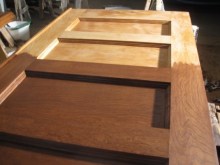
Then back to current reality.  There are fourteen doors in all, and I can run three at a time through staining and topcoating—it takes more than a week, given that two sides have to be done in sequence.

In a daring move, I manoeuvre around the doors to start in on a load for the rack: the
cornices, friezes and other pieces of the window and door framing.  This signals progress, but my mood is dominated by the 20 or so ruined casements—what to do?

oct 8 2