The work of rounding sponsors seems to be falling to me.   Two days ago, I approached our lighting source, who prudently asked what a company would get in return for chipping in 5% for a sponsorship.  Good question—I had little idea, and so queried Marc.  He responds, with typical thoroughness, by listing a dozen opportunities for publicity, leaning heavily towards an audience of architects.  I gladly pass this list on to our lighting source, who quickly signs on.

From lights to water….Marc has been chewing, again and again, on the question of how to harvest rainwater.  I initially espoused the idea of simply recharging the ground, but it turns out there are LEED points at stake.  So he proposes HOGS—vertical plastic cisterns which serve as walls.  I raise a few questions about their viability for a cold climate, how they would appear, and end by suggesting a scaled-back approach.  In truth, I find it easier to dump the water than hold it for reuse.

Marc and Joe Messier of SALA, Caleb and Joshua Crentz of Morrissey Builders and I conferred for 3 ½ hours by phone this morning.  Joe had worked up an analysis of how the house might achieve LEED Platinum status.  It would involve, paradoxically, both maximizing capture of rainfall and maximizing drought-resistant plantings.  Marc has estimated the entire process of achieving GreenStar Gold, LEED Platinum and the Living Building Challenge ‘net zero’ status at about $25,000, mainly in staff time.  I am interested in all three certifications because they have different valences: GreenStar for upper Midwest builders, LEED with its national recognition, and Living Building Challenge because it has an esthetic dimension and involves proving that the house actually performs (unlike LEED and GreenStar which evaluate only design and construction—not operation.)

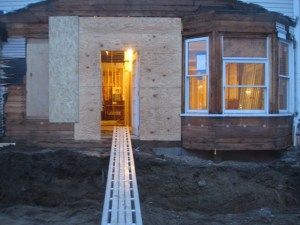
The house at 2021 looks ever more shabby.  Now its nose has been torn off—the porch removed.  The yard is impassable mud and mess, particularly when it rains. Have we reached bottom?

dec 1

A second bid for the cabinets (kitchen, baths, etc) arrives, from a local cabinet-builder. I am feeling pressure to choose—between this one and a large national firm.  Caleb wants to install the cabinets in February, and the lead time is eight weeks.  A word of counsel comes in from Sean, who emphasizes picking a cabinetmaker who can maximize our LEED points.  At issue is conventional plywood, which emits formaldehyde, vs “Purebond” plywood, which does not.  Actually, that is a no-brainer.  Our house will be so tight that we cannot afford much off-gassing of formaldehyde.

Energized by a Thanksgiving rest, I apply a final coat to miscellaneous pieces of trim.  Done!  And am eager to take on the next load of window and doors casings and headers, once they are cut.  The house needs two times more new trim than the existing trim that I with students have spent two months or more refinishing.

Good news for those who love to cook turkey and other comfort foods.  I learn that our existing range hood—installed two years ago—doesn’t suck out kitchen air very fast because it was installed three inches too high, and because it diminishes its power by sucking greasy air through a screen.  So we are advised to try a Vent-a-Hood, which deliciously flings grease centrifugally onto a washable panel and so dispenses with a screen.  I like the concept.  Needless to say, it costs more.

Speaking of costs, I alert everyone that the three bids for building all our cabinets are in.  One is $10,000 higher than the other two, but one of the remaining two can’t use formaldehyde-free plywood for some reason.  More negotiation needed.

After much swaying to and fro, Linda and I decide to get a ventless heat-pump dryer.  The choices were: a clothesline (not practical), a ventless dryer (to avoid losing heat to the outside) or a dryer driven by a heat pump (to save energy).  We decided to combine the two, in buying what seems to be a new offering from Whirlpool.  The stickler was the fact that the ventless heat pump dryer lacks a ‘steam’ cycle.  Linda decided she could do without once, since she will no longer be dressing for the office.  But to hedge our bets, I ask Marc and Caleb to punch a hole in the wall (and cover it up) just in case need to get a vented dryer sometime down the road.

As if by intuition, Marc writes me an email that answers all the questions that had been stirring around for weeks about the front and back doors.  Linda and I visited a local Andersen window and door outlet, which brought all the questions to the surface.  Once home, we see Marc’s email which lists all the attributes we want in the (hugely expensive) Andersen doors.  Including color!  We discover, and like very much, a ‘stormy blue’ to provide an accent to the dominant greys of the house.  Hooray! Check that problem off the list.

Marc points out that the lighting schedule is incomplete, and I supply a few more preferences.  The decisions are flowing thick and fast.

I learn, to my disappointment, that standard cabinet fabrication involves the use of vinyl on the interiors.  Linda and I would rather see real wood.  Moreover, on Marc’s advice, we ask the cabinet bidders to include formaldehyde-free plywood.  With our tightly controlled air system, we’ll need to avoid as much of such off-gassing as we can.  Both these preferences are sure to drive up the costs of the cabinets.

Marc has sent images of ornate black Victorian grates or registers for the heating system, but we’d rather keep them invisible by using simple wooden grills that blend in with the floor at its juncture with the wall.  The stained trim will provide enough of an accent to the rooms.

Sick unto death of staining and refinishing the door and window trim, I query Accent’s David Klemenhagen about the possibility of Accent’s enormous workshop taking on the task of finishing the large volume of lumber that will come down the pike in January.  Fully 2/3 of the house’s door and window trim, and baseboards, are still needed, to say nothing of an additional 10 doors.

The 20th trip to Minneapolis: Caught a tailwind yesterday to Minneapolis—averaged 44 miles per gallon in our Corolla.  The day begins with an unpleasant encounter with a neighbor up the street that severely rattled my cage.  This being Friday the 13th, there was other bad news as well.  First, survey markers were planted and show that our neighbors to north and south both have transgressed our property line by a foot or more, with constructions that will be awkward and difficult to remediate.  Second, a massive rainstorm sent water into the freshly paved basement last week—for the second time in two months!  The problem is that the wall assembly to keep out water is not yet complete, as Marc explains at length in an email.   He assures me that no system can stop all water, and that the wall assembly when complete will keep virtually all water out, and allow what does get in to evaporate harmlessly.  I’d be more comfortable with 100% exclusion, and am guessing that in his cautious way he is asserting that we will not get enough water in to cause any problems.

Things look better in the basement, where Caleb’s crew has torn up the broken old floor, laid down 2 inch-thick foam insulation, then poured a new floor.  Much better…but yet another change order, since this work was not envisaged in the original contract.


And on the first floor, the structural work proceeds. A temporary wooden brace holds up a steel beam that makes it possible to have an open entryway.

The open entry truly is open at this point….

Another sign of more-progress-to-come are the sturdy struts being inserted all around the house just above the foundation; these will support the wall structures that will hold thick blocks of insulation.

I devote much of  the morning and all afternoon to interviewing, serially, three competing cabinet builders—for the entire array of cabinets in the house.  Each of these conversations takes two hours as I present all the particularities of what we want.  Quite an unloading.  In between, I meet with Marc and Pat O’Malley, a seasoned LEED rater, who explains the process.  I think we are ready to sign on.  Then I race home at a mere 38 miles per gallon.  Where’s my tailwind?

Sean, head of Morrissey Builders, has been talking up the idea of monitoring the house long term to see how the various systems function.  That, he says, is rarely done.  As usual, I am happy to have the house serve as guinea pig, so Marc and Sean meet with a local expert in the performance of building systems, Pat Huelman, a professor at the U of M.  Sean also would like to do outreach in the elementary schools; I can see the kids relating to him.  And I begin to concoct a variant on ‘three little pigs’, to plant the value of insulating buildings.  Could be fun.