I arrived last night late (the 17th trip), and leave the motel (Super8 in Golden Valley) around 6. Daughter Elizabeth kindly left me a big package of baked goods on her porch—where a squirrel almost got them before I got there.   Caleb and I meet at the house.  The interior is gaunt—really stripped out.

The foundation for the addition on the back looks solid enough to support a tank.

The garage is getting a new roof to support a dozen solar panels at the right angle for our northerly latitude.

Then we meet Marc at the SALA office in Nordeast, which I had not yet seen.   We sit in the spare conference room from  9:30 through 3:30—finish up the GreenStar checklist, then address one construction issue after the next—the Andersen window order, the door list, the pending huge lumber order.  All in all, some 20 separate items.  We could have kept going all day and night.

Then Caleb sends me a slew of emails right after our meeting.  These include a construction schedule—17 out of 68 items are done.   And competing bids from landscapers. These are so expensive I ponder the idea of simply doing all the landscaping myself.   Caleb further suggests more tile and appliance suppliers.  I check out a few, mostly in Plymouth.  Linda and I settle upon a few porcelain tile patterns.   But there are some small outfits that hand-make tile.  I would love to see such in our house—like a traditional scallop design.

I return to the house to dig out a second line of hostas for replanting in Fargo, and gladly haul them home.
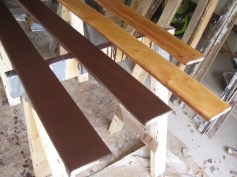
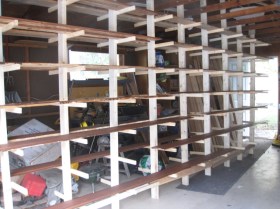
Disaster strikes!  That is, I cause a disaster by not paying attention to what was going on.   I invite two of my best student workers over to sand the casings before applying the topcoat, and I accidentally give them a couple dozen casings which had only stain, not the first topcoat.  The students get them done, and I proceed to topcoat them, noticing not really registering the fact that the color is off—too yellowish.  By the end of the afternoon, the mistake is clear.  The casings look horrible—bleached, uneven in tone.  I can’t blame the students, of course, so put on a stiff upper lip and thank them.   But the only way to rectify the error is to return to scratch—strip off the new topcoat and stain.  Linda counsels me to not do anything rash.  Why not?  I feel sick.

I begin a second round of staining, this time casings, of which there are dozens.  I spend all evening researching appliances—we need to make selections so the plumbers know where to rough-in.

Caleb, Josh Crenshaw (Morrissey Builders expert in green certification), Marc and I spend more than 3 hours on a conference call, hashing through the GreenStar checklist.  With some embarrassment, Caleb announced that a huge rainstorm soaked into the new Cocoon insulation around the basement.  (The gutters and downspouts were shambles when we bought the house.)  Unfortunately, the water passed into the basement as well.  I am assured that the problem will go away once the Cocoon insulation is raised to its full height and covered with stucco.

Caleb reports that the demolition of the interior of the house well along.

I send Xcel proof that we are being permitted to drill the geothermal wells.  Somehow this bears upon our application for the “Solar Rewards” program.  I guess Xcel just wants to know we are serious.  The geothermal permits should do the trick, along with the energy modelling which is in the process of updating.  Our project is very well documented, particularly to meet regulatory requirements.  Marc crafts documents with such care.


The 2021 Harriet house has a massive poured front stoop and steps, which I am hoping to retain (pouring concrete does add to global warming).  However, the steps are narrow and I’d like to extend them—which would mean drilling in rebar and pouring concrete.  Feasible?  I work up a sketch for Marc, once I get the dimensions from Caleb.

I start a schedule of walking home from the office in mid-afternoon, changing into foul garments and mucking about with the stain and the sealers (General Finishes’ Seal-a- Cell, red can). Sanded the first topcoat and applied the second (General Finishes’ Armor Seal, green can). Ah, how it glistens when it goes on (by foam pad covered in thin terrycloth). But it will harden into a dull satin finish.

sept 28

The sanding is finally finished—took about a month. Now the staining and top-coating begins.  This I resolve to do myself, so that I alone will be responsible for future mistakes.  So I stain as much baseboard as I can load up on the rack.

Marc educates me by email about foam insulation.   The roof and walls are going to be enveloped in EPS type 9, a new product by LaPolla, a company in Texas.  Apparently this foam has a low “GPS”—a measure of contribution to global warming.  The standard foam, XPS, is more than a thousand times more potent than carbon dioxide.  Of course, it is cheaper than EPS, but we’ll eat the difference.

My 67th birthday today should present no obstacle to the project moving forward.