Marc (architect) sends a detailed discussion of possible certifications. Linda and I want to make this house a resource for others to imagine how they might pursue net zero. To that end, we need to establish its credibility. Marc suggests: LEED, GreenStar, Living Buidling Challenge, and then setting up the house for tours by architects and builders, like the Homes by Architects, MN Renewable Energy Tours, etc. Amen!
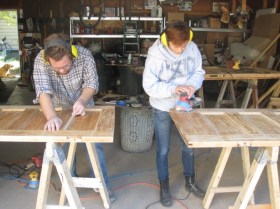
Solvei and Levi put in a heroic effort, sanding a total of four doors—finishing all but one door.
I celebrate by building a drying rack—9 studs attached to the garage rafters, with seven crosspieces sticking out a foot on each side. I estimate capacity at 200 linear feet of trim—400 if I can double load the ‘shelves.’
It’s been a week since I’ve been to the office. This project is becoming all-consuming. And I am not even on-site! Where things are getting more expensive….for example, the electrician came through with a sky-high bid. Fortunately, Caleb walked him around and was able to bring down the bid by thousands of dollars. We are wiring the house not only for convenient outlets and switches, but for future needs, as well as we can anticipate them.
With Marc’s support, I decide not to use high-end and very pricey shingles on the roof. Hardly worth it, for half the roof will be entirely covered with solar panels.
Groundbreaking! The Cocoon people were at work by the time I get to the house—one with a long wand, blasts the first four inches of dirt around the house with high-pressure water, then another with a thick vacuum house sucks it up. I was amazed how clean a cut they can make, right down to the footing at 6 feet.


Then they insert a 2-inch thick board of white insulation, and squirt in another 2 inches of foam between the board and the freshly washed foundation wall. Voila! The basement is insulated to R-x without having disturbed the flower beds! Well, in theory.
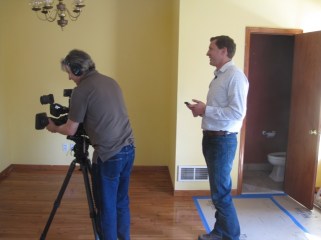
David Gillette of the “Almanac” series on public television, is there for a first shoot. He interviews me with intelligent questions, then proposes to come back at the halfway point, and then when the house is complete, to eventually produce a feature.
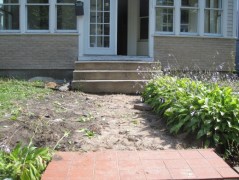 I dig up half a dozen hostas to replant at our Fargo house, and happily vamoose northward.
Stop for a long and fruitful conversation with a cabinet designer in Plymouth. Busy two days, on several fronts. The project is rolling.
Meet with Caleb and Marc for five-six hours, mostly hashing through the endless GreenStar checklist of environmentally sound practices in building. We make it perhaps one-third the way through. I am surprised that most of the preferences I registered back in April hold up to critical scrutiny. If GreenStar offered platinum, we’d make it. Wobbling out of our meeting, I treat myself to a visit to Cambria downtown, for countertop material, then tile showrooms in Plymouth. Of course, the most gorgeous tile cost $500 per square foot. We’ll settle for handsome porcelain tile at $5-7 per square foot.
The 16th trip to Minneapolis: I put two more temps to work on sanding all morning, and promise them more work when I return on Thursday. Listen to Conrad’s Heart of Darkness on the way to Minneapolis. What a Victorian shudder of a story.
Neighbor Mekonnen (just to the north) calls, requesting to harvest the windows on the porch. He’s been eager for anything I cast out of the house. He’s planning a gazebo, and also wants to scavenge from our house to restore his next door. I am happy to oblige, and don’t want to make a market haggle out of what should be simple neighborliness.
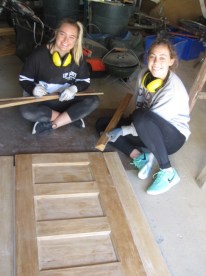
Two more Concordia students, Jenna and Madeleine, show up early on. I turn them loose on a ‘puzzle’ – reconstituting the frames around the doors. They take to it with gusto, scouting for the three pieces of the header over the doors (cornice, frieze and taenia), then the casings at either side, and finally the stubby plinths below the casings. I sorely wish I had marked every piece as I pried off the trim in July and August—that would have saved much detective work.
In a fit of enthusiasm, I build 9 frames, consisting of a tall 2×4, each with 7 crosspieces at one-foot intervals. Each crosspiece extends out a foot from each side of the vertical. Attached to the rafters of the garage, this forest of sticks can host 200 linear feet of drying lumber—or 400 feet when I double up on the foot-long ‘shelves.’ Let the staining begin! But sanding comes first. Concordia students Erica, Maddie, Solvei, Robert and Libby have been doing good work when they can. But since students are not available when needed, I turned to a temp agency, and two well-worn guys came over. Vern and Rodolfo put in more four hours of hard work each at $20/hour. Definitely worth it. I am sorry they keep only half of what I pay their agency.
 Whittier Netzero