I work up a detailed accounting of what we have in the way of trim –cornices, pencils, casings, and plinths for windows and doors, and fly it by Caleb. He is a carpenter by trade, and I’d rather have him finalize order—which will be enormous.
It dawns on me that if this project is truly one of very few hundred-year-old houses renovated to net zero, we ought to be aiming for LEED as well as Green Star certification. Marc tells me that LEED require that the rehab be total, as in “total gut rehab”, rather than partial. We are a partial, because Marc is hoping that we might save some plaster, 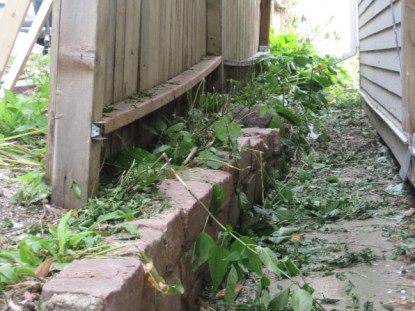 and in any case, we are not taking the house down to the studs. Still, he’s going to see if we might qualify as an exception.
In the spirit of reusing what we have, I suggest that we take the 100+ quartzite blocks from the crumbling retaining wall, saw them in half, and ‘pave’ a path from garage to house with the smooth cuts facing upward.
And that we take the foot-square pavers in front and along the other side of the house and reallocate them to the patio Marc is proposing for the backyard. In short order it becomes clear that the quartzite is much too tough to cut, while Sean points out that the (cheap) pavers have reached the end of their useful lives. So we lose another few Green Star points, alas.
Our 14th trip to Minneapolis: This was a floating meeting, starting at 9 and running until 2, variously with Marc, Sean and Caleb. We devote much discussion to the ‘jamb boxes’—the foot-wide spaces between wall and window, thanks to the beefed up exterior insulation. The Andersen window order has to be finalized by October; I have come to appreciate the long lead time. Endless consultation needed.
I report what little progress Linda and I have made in deciding finishes: we are agreed now on solid (as opposed to oriented-strand) bamboo flooring in the family room, sunroom and kitchen. (I have hesitations about the latter—what if we ruin it?) We also need to decide upon porch flooring. “Nylo” is not available; Sean recommends fir, but I am leery of the repainting that will be required.
Best of all, we arrived at a meeting of the minds regarding the drainage system, my special passion. There will be two sets of ‘FloWells” (front and back) to capture the hundreds of gallons that flood off the roof in major downpours. The FloWells—plastic buckets two feet high and two feet wide—will hold the precipitation until it seeps into the ground. As for runoff from the garage, I suggest that we perch a skinny vertical tank under the eaves—out of sight!—and use that to feed our drip irrigation system. We abandon the idea of a rain garden. I can’t see the value in one, given our small plot, the absence of major pollutant flows needing to be cleansed, and the likelihood that we’d have to irrigate the plantings if the weather turned dry.
Marc takes me aside at the end of the meeting to alert me to the fact that to keep within the 12% fee we had targeted, he would have to devote at most 4 hours per week from here on out. I take a deep breath and urge him not to hold back. We do need his continuing involvement, due to his broad knowledge of the technologies, design, and his experience.
Linda and I close out the day with more shopping—found intriguing porcelain tile at Carpet One, and a number of promising fixtures at Southern Electric next door.
Good news arrives. To my astonishment, Xcel calls with the news that the Public Utilities Commission has authorized Xcel to treat our house as new construction. Marc exults: “HUGE congrats to you to get them to consider your project on it actual design and not just routine remodel.” For my part, I am just amazed and gratified that the PUC has authorized Xcel to use best judgement in dealing with a unique situation.
Our mortgage lender tells me she is aiming at a closing next week. Please let it happen.
Another occasion for worry—do we have enough electrical outlets? I query Marc with a few more suggested placements. It is far cheaper and easier to get things right the first time. Marc and I already have been through two detailed iterations of where to place outlets and switches—good mental exercise, in imagining where such would be most conveniently located. We even include one for the Christmas tree in the parlor. Today I am worried about outlets on the outside wall for running our electric snowblower.
While in Minneapolis last week, Linda kindly sat in the car while I made a run up to the Public Utility Commission office, seeking someone to talk to about the rigid eligibility rules of the Solar Rewards program. All I got was a name, and after losing that a few times, I wrote to a Susan MacKenzie, who graciously and supportively forwarded it on to the right person in Consumer Affairs. Today I also wrote Xcel, to keep them in the loop. Fingers crossed; it make sense if our solar project was slotted as pertaining to new construction rather than a retrofit, given the near-total gut rehab that we are engaged in.
More deliberations about the color of the house. All elements are interlinked—house color, window trim color, sash color. One problem is that Linda and I have not settled on a house color—grey seems to be the main contender, although it seems inherently dull. Marc sends along a tinted computer image of the house, however, and I am surprised how bold the house looks in darkish grey.
The loan process drags….Our lender tells me that the voluminous financial revelations we attached to our loan application are being reviewed by the underwriter and that the next and final step is approval by the bank’s review committee. End of the tunnel? It has been almost a month since the appraisal was completed.
I share this blog—up to date through April only—with Sean, Marc and Caleb, and ask their candid comments. I also offer them the opportunity to join with me in authoring it. In this post-post-modern era, no one voice dare be hegemonic. But apparently there are no takers.
Linda and I continued shopping on our own—found a gorgeous swirly new countertop material at Cambria’s elegant showroom downtown. Then two quick visits out in Plymouth for tile and stone, after a stop back at ProSource, which has been very helpful—perhaps for kitchen cabinets?
Back on email, Caleb follows up on our meeting by raising a very practical question about our water management strategy from the perspective of Green Star certification. How are we going to hold 650 gallons (calculated runoff from a one-inch rainfall). I run the calculations and realize that my trench system will not be sufficient—the pea rock takes up more than half the trench. Still, we’ve never had a backup or overflow, and that despite a few 1-2” rains.
Our scheduled three-hour meeting went for four hours. With the help of Sean, Marc and Caleb, I decipher opaque references in the Andersen window bid. Some of our windows are ‘double-hung’ sashes, for a traditional look. Some are casements, where required for escape routes, some are picture windows large are small, where we don’t anticipate needing ventilation. And the remainder are ‘awning’ windows, hinged on the top to swing out a few inches, where only ventilation is needed. The needed information is on the Andersen bid, it just needs to be quarried out.
I’ve been devoting much nighttime thinking to the design of a drainage system. My goal, shared by Green Star (!), is to keep all precipitation on the property, soaking into the ground rather than spilling into storm drain. I offer an eager endorsement of the system we use in Fargo: downspouts on house and garage, feeding into drain tile whose perforations let the water seep into two feet of gravel—all invisibly. No gutter extenders, no swales, no ponding on the grass. And little mess was involved: 4-inch-wide trenches dug with a ‘ditchwitch’. But I am not able to articulate a plan that catches on.
In the afternoon, Linda and I continue shopping with Marc: Lappin Lighting in downtown Minneapolis, where we pore through catalogs for the wrought-iron look in ceiling fixtures. Then we visit a former project by Sean, a house in Como Park that was rebuilt from ground up, including simple but very attractive all-wood cabinets by J&R—Amish cabinet builders in central Illinois. Very solid, even if the door spacing strikes me as inconsistent.
 Whittier Netzero